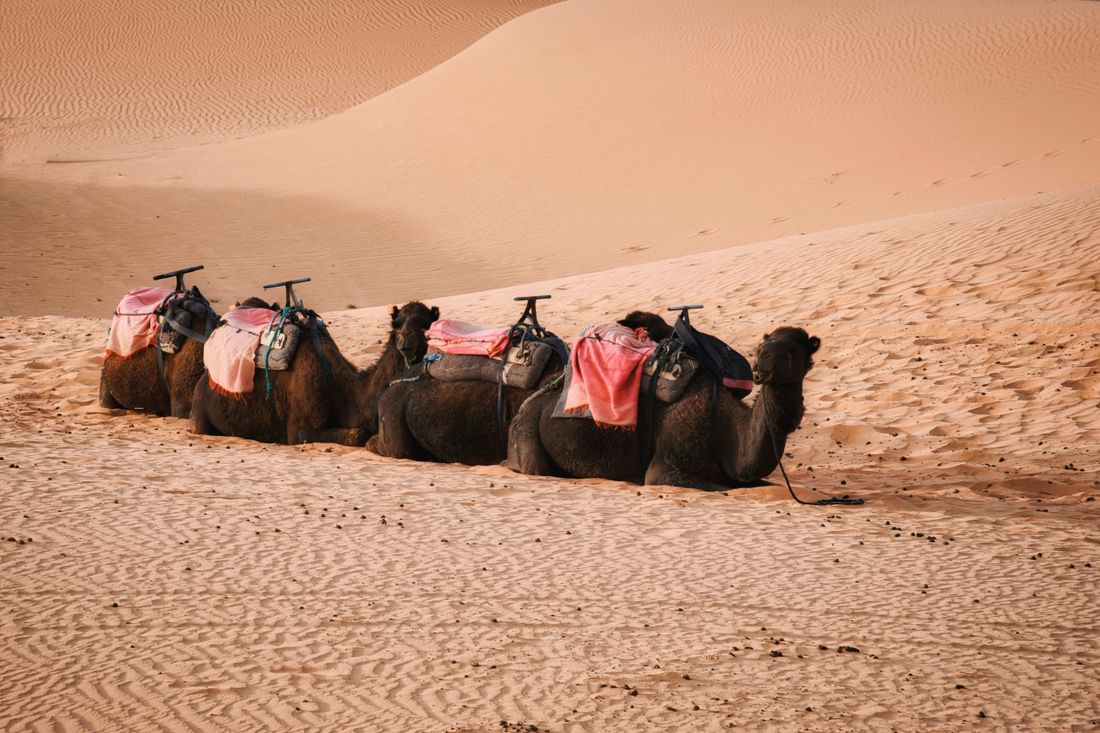
01
Journey stage
Cross the High Atlas via the Tizi n'Tichka pass
This is a one-way journey from Marrakech to Fes.

A five-day express crossing from Marrakech to Fes — the Atlas, Aït Ben Haddou, the Sahara, and Fes, without the extra nights.
Duration
5 Days
Difficulty
Easy–Moderate
Elevation
Up to 2,260 m
Best Season
Oct–Apr
Start
Marrakech
Private
Yes
Start
Marrakech
End
Fes
Distance
Approx. 800 km driving
Format
Private & customizable
Difficulty profile
A practical seven-step scale built from the route data on this page. It is intended to help you compare journeys, not to replace medical advice or a guide's on-the-ground assessment.
2/7
Easy–Moderate
Easy–Moderate
5 Days
Up to 2,260 m
Marrakech
Approx. 800 km driving
Oct–Apr
Why this rating makes sense
With a difficulty rating of 2, this journey is accessible to most travelers in reasonable health who can tolerate extended road travel and a camel ride of roughly an hour. The main challenges are the long transit distances, basic desert camp conditions, and the possibility of rough terrain on desert tracks. It is not suitable for those with mobility limitations or who struggle with heat, dust, and limited amenities. No trekking or technical fitness is required.
The radar is a planning aid derived from the route information already published on this page; it is not a medical or technical grading.
Why This Journey?
This is for travelers who want the classic Morocco crossing — Marrakech to Fes via the Sahara, the great route through the Atlas, the kasbahs, the gorges, and the dunes. The journey most travelers dream of.
Journey overview
This is the grand tour compressed — five days instead of seven, covering the same ground but with fewer stops. It is for travelers who want the full Marrakech-to-Fes crossing but have limited time. The driving days are long, but every day delivers something major: the Atlas crossing, Aït Ben Haddou, the Sahara dunes, the Ziz Valley, and Fes.
It is planned as a 5 days experience with the route beginning in Marrakech and finishing in Fes The listed difficulty is easy–moderate with a stated high point or elevation of Up to 2,260 m and an approximate distance of Approx. 800 km driving. The current itinerary data lists Oct–Apr as the best season.
The journey is structured around Day 1: Marrakech to Dades Valley via Aït Ben Haddou (Marrakech → Tizi n'Tichka → Aït Ben Haddou → Dades); Day 2: Dades Gorge, Todra Gorge, and on to Merzouga (Dades → Todra Gorge → Merzouga → Erg Chebbi); Day 3: Sunrise on the dunes and drive to Fes (Erg Chebbi → Merzouga → Middle Atlas → Fes); Day 4: Fes guided tour (Fes); Day 5: Departure from Fes (Fes). Key elements include Cross the High Atlas via the Tizi n'Tichka pass; Visit Aït Ben Haddou UNESCO kasbah; Drive through the Dades and Todra gorges; Camel trek into Erg Chebbi dunes.
This is for travelers who want the classic Morocco crossing — Marrakech to Fes via the Sahara, the great route through the Atlas, the kasbahs, the gorges, and the dunes. The journey most travelers dream of. Expect long driving days covering significant distances, broken up by stops at kasbahs, oases, and viewpoints. The route typically includes Ait Benhaddou, the Todra or Dades Gorge, and a camel trek into the dunes at Erg Chebbi for an overnight desert camp. Accommodation ranges from city hotels in Marrakech and Fes to simpler guesthouses in the oases and a desert camp with basic facilities. Meals are largely Moroccan standards like tagine and couscous, often served at the accommodation. The journey ends in Fes with time in the medina. With a difficulty rating of 2, this journey is accessible to most travelers in reasonable health who can tolerate extended road travel and a camel ride of roughly an hour. The main challenges are the long transit distances, basic desert camp conditions, and the possibility of rough terrain on desert tracks. It is not suitable for those with mobility limitations or who struggle with heat, dust, and limited amenities. No trekking or technical fitness is required.
For the guest
For guests who want several sides of Morocco in one private journey, the strength is the contrast between landscapes, cultures and travel rhythms rather than simply counting how many places are visited.
If you are researching marrakech to fes, this page is designed to answer the questions that matter before booking: what the days feel like, who the route suits, what the route includes and what conditions to prepare for.
The practical side matters too: this is a easy–moderate journey over 5 Days, with the best travel window listed as Oct–Apr. With a difficulty rating of 2, this journey is accessible to most travelers in reasonable health who can tolerate extended road travel and a camel ride of roughly an hour. The main challenges are the long transit distances, basic desert camp conditions, and the possibility of rough terrain on desert tracks. It is not suitable for those with mobility limitations or who struggle with heat, dust, and limited amenities. No trekking or technical fitness is required.
About the Region
This journey spans three of Morocco's most distinct geographic zones: the Marrakech region at the foot of the High Atlas, the arid pre-Saharan corridor leading south through Ouarzazate and the Draa Valley, and the northern Fes-Meknes plateau. The southern stretch crosses the Tizi n'Tichka pass at over 2,200 metres before descending into the rain-shadowed valleys where kasbahs and palm oases line the roads. The Sahara section reaches Erg Chebbi near Merzouga, a field of dunes rising to 150 metres on the Algerian border. The final leg climbs back through the Middle Atlas cedar forests to Fes, one of Morocco's oldest imperial cities.
Continue planning Morocco
Compare this Marrakech to Fes via Sahara tour with the places and practical guides that help travelers understand the route before booking.
Morocco travel guides
Journey highlights
A route-specific field guide built from the places, highlights and activities already recorded for this journey.
Journey stage
This is a one-way journey from Marrakech to Fes.
Journey stage
The driving is long but the scenery is spectacular.

Dades Valley, Morocco
The Middle Atlas section includes cedar forests near Ifrane.
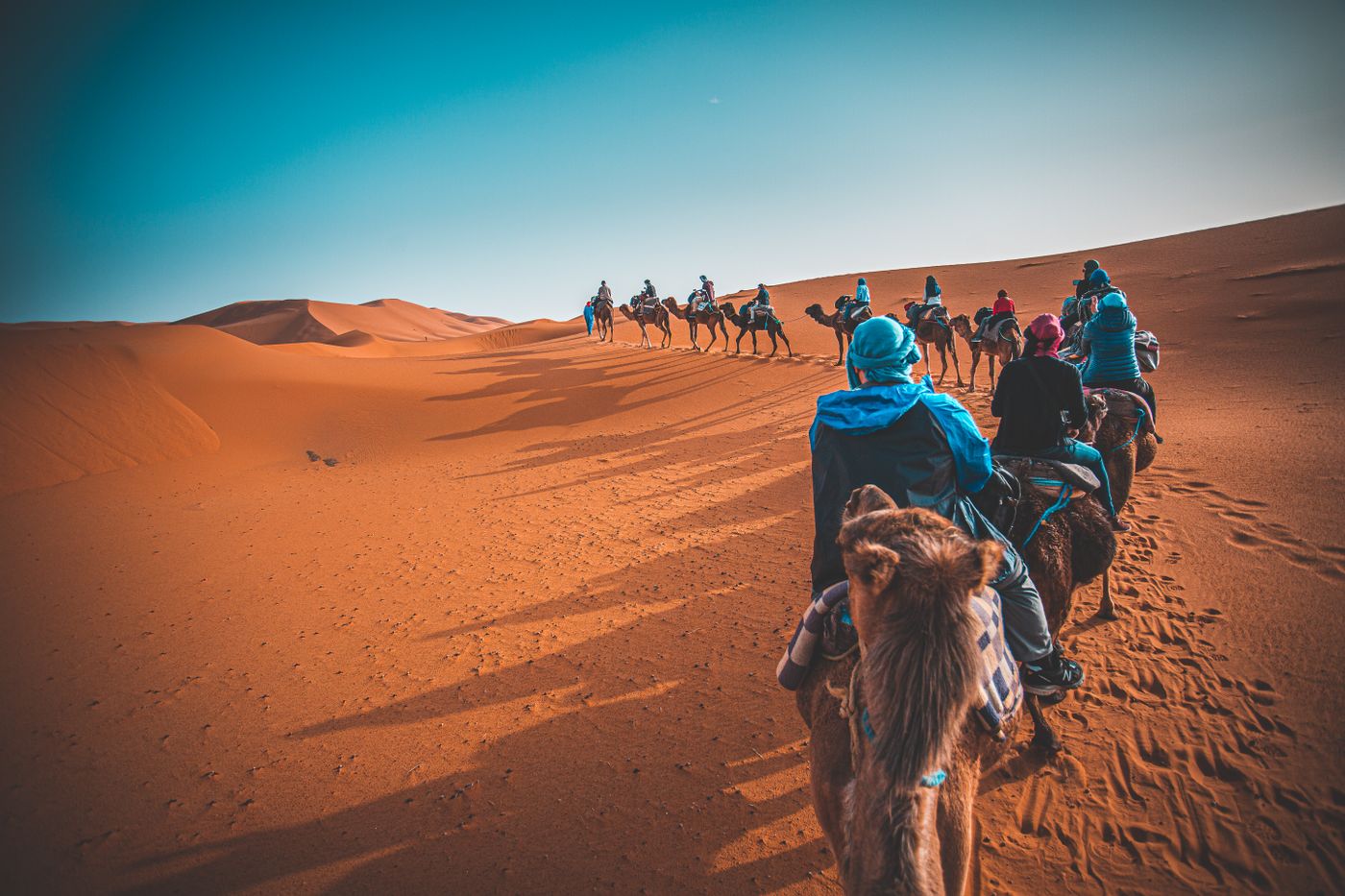
Merzouga and Erg Chebbi, Morocco
Best from October to April.

Merzouga and Erg Chebbi, Morocco
This is for travelers who want the classic Morocco crossing — Marrakech to Fes via the Sahara, the great route through the Atlas, the kasbahs, the gorges, and the dunes. The journey most travelers dream of.

Fes, Morocco
This is for travelers who want the classic Morocco crossing — Marrakech to Fes via the Sahara, the great route through the Atlas, the kasbahs, the gorges, and the dunes. The journey most travelers dream of.
Journey stage 1
Depart 08:00
Journey stage 1
Depart 08:00
Journey stage 1
Depart 08:00
Journey stage 1
Depart 08:00
Journey stage 2
Dades Gorge, Todra Gorge, and on to Merzouga
Journey stage 2
Dades Gorge, Todra Gorge, and on to Merzouga
Good to know
Travelers who want to cross Morocco from Marrakech to Fes
Good to know
Those who want the Sahara in a one-way journey
What to experience
A visual route guide built around the actual places and experiences named in this itinerary. Each photograph is chosen from the matching location pool, while the note beside it explains why that moment matters to a guest.
Dades Valley, Morocco
This section is about the journey through the landscape as much as the destination itself. Drive through the Dades and Todra gorges gives guests a sense of the terrain and the changing scenery, while the itinerary provides the practical driving and walking information needed to plan it realistically.
Merzouga and Erg Chebbi, Morocco
This is where the Sahara becomes an experience rather than a backdrop. Camel trek into Erg Chebbi dunes gives guests time to notice the scale of the dunes, the light and the quieter rhythm of the desert, with the exact camp and route details set out in the itinerary.
Merzouga and Erg Chebbi, Morocco
This is where the Sahara becomes an experience rather than a backdrop. Overnight in a Sahara desert camp gives guests time to notice the scale of the dunes, the light and the quieter rhythm of the desert, with the exact camp and route details set out in the itinerary.
Fes, Morocco
Expect a more sensory part of the journey here: architecture, movement, craft, food and the small details that are easy to miss when a city is rushed. Continue through the Middle Atlas to Fes is presented as part of the route so guests can understand why this stop matters, not just where the photograph was taken.
Gallery
16 photos
Route & Map
Key locations on this journey. Markers show the verified waypoints available for this route; the map does not claim exact trail geometry.
Day-by-Day
This is a suggested itinerary. Every journey is adjustable — pace, activities, and accommodation.
Driving
6–7 hours
Timing
Depart 08:00
Meals
Lunch, dinner
Accommodation
Guesthouse in Dades Valley
Walking
1 hour camel trek
Driving
4–5 hours
Meals
Breakfast, lunch, dinner
Accommodation
Sahara desert camp
Driving
7–8 hours
Timing
Sunrise 06:00, arrive Fes by 18:00
Meals
Breakfast
Accommodation
Hotel in Fes
Walking
5–6 hours
Meals
Breakfast, lunch
Accommodation
Hotel in Fes
Meals
Breakfast
Accommodation
Not included
What You Will Experience
Expect long driving days covering significant distances, broken up by stops at kasbahs, oases, and viewpoints. The route typically includes Ait Benhaddou, the Todra or Dades Gorge, and a camel trek into the dunes at Erg Chebbi for an overnight desert camp. Accommodation ranges from city hotels in Marrakech and Fes to simpler guesthouses in the oases and a desert camp with basic facilities. Meals are largely Moroccan standards like tagine and couscous, often served at the accommodation. The journey ends in Fes with time in the medina.
Journey character
Physical Demands
Long driving days (up to 7–8 hours)
Winding mountain roads
1-hour camel trek
Walking on sand
Early starts
Best Time to Go
The October to April window avoids the extreme summer heat of the Sahara, when dune temperatures can be dangerous. Spring and autumn months within this range offer the most comfortable conditions for both the desert sections and the mountain passes. Winter crossings can encounter snow on the Tizi n'Tichka pass, occasionally causing delays or rerouting. Nights in the desert are cold throughout this period, especially from December to February.
Is This Right for You?
Travelers who want to cross Morocco from Marrakech to Fes
Those who want the Sahara in a one-way journey
People comfortable with long drives
Anyone who wants to see the Atlas, desert, and imperial cities
Those who get car sick on winding roads
Travelers who prefer short driving days
Those who want active trekking rather than a road journey
What's Included
Private 4x4 with driver
Camel trek
Desert camp accommodation
2 nights guesthouse
Breakfasts and dinners
Lunches
Personal non-alcoholic beverages
Travel insurance
Tips
Accommodation in Fes
Practical Information
Guesthouses and Sahara desert camp. Basic but authentic.
Private 4x4 vehicle with professional driver.
Breakfasts and dinners included. Moroccan cuisine.
What to Pack
Sun protection
Warm jacket for desert night
Scarf for sand
Comfortable clothing for long drives
Closed shoes
Water bottle
Headlamp
Camera
FAQs
Yes — the journey can be done in either direction. Contact us to arrange.
This is primarily a road journey with approximately 800 km of driving over 5 days, with stops at key sites along the way.
Yes — the route can be reversed. Contact us to arrange a Fes departure.
This is a starting point. We will tailor every detail to your dates, interests, and travel companions.
From
Marrakech
Related Journeys